
LINKS
Sam Ristich Nature Trail | Nature Groups | Conservation Groups | Amanita ristichii | Publications | Contact | Credits & Thanks
SAM RISTICH NATURE TRAIL
Click here for map and brochure about the trail.
North Yarmouth Conservation Commission
This half-mile trail with 16 stations (post markers) on Town property behind North Yarmouth Memorial School is for the enjoyment, observation and identification of flora and fauna. Sam led public walks here once a month (in season) until he was 90 years old. Trail can be accessed from Parsonage Road. Look for blue trail sign at crosswalk. Parking is available in the lot by the ball field or in Public Works lot near the sign.
Why are Trails Important? by Sam Ristich
- Inexpensive method to get physical, mental, spiritual therapy.
- Inexpensive convenient way to enjoy companionship, community and family.
- Seasonal way to enjoy natural history.
- Additional way for schools to educate and instill a sense of wonderment especially in young children.
Function of trails
- Great way of having a togetherness without traffic and noise.
- Great mental therapy.
- Learning process.
- Sense of wonderment. The forest is a combination of producers and recyclers that produce oxygen, wood, food, leaves, lichens, ferns, fruits, seeds, condominiums for birds and rodents. Recyclers are fungi, birds, mammals and insects.
- Patterns.
Sam belonged to these organizations, and he lead walks, talks and classes. Nothing would please him more than for you to volunteer, or to sign up for a walk, talk, or class!
Sam Ristich Nature Trail | Nature Groups | Conservation Groups | Amanita ristichii | Publications | Contact | Credits & Thanks
NATURE GROUPS
Adirondack Mountain Club
http://www.adk.org/home-flash.aspx
Lake George, New York
American Chestnut Foundation — Maine Chapter
http://www.me-acf.org/Home.html
glenrea42@msn.com
231 Buck Street Bangor, Maine 04401
207-945-6945
Audubon Society of Maine
Sited along the Presumpscot River estuary just five minutes from Portland, Maine Audubon’s headquarters features a modern environmental center and a 65-acre sanctuary with more than two miles of trails winding along a pond and through woods, meadow, orchard and salt marsh.
Gilsland Farm
P. O. Box 6009 [or 118 US Rt One] Falmouth, Maine 04105-6009
The New York Botanical Garden
The NYBG is an advocate for the plant kingdom and is located on 250 acres in the Bronx--including 50 acres of the largest remaining expanse of the majestic woodland that once covered New York City. The Garden pursues its mission through its role as a museum of living plant collections arranged in gardens and landscapes across its National Historic Landmark site; through its comprehensive education programs in horticulture and plant science; and through the wide-ranging research programs of the International Plant Science Center.
Sam taught evening and weekend classes in winter botany and mushroom identification at the Garden for ten years while he worked at the Boyce Thompson Institute for Plant Research in Yonkers, NY. Alumni of his classes include Gary Lincoff and Carol Levine, Roz Lowen, Sandy and Jerry Sheine, and many others.
Entomology Society of America
Humboldt Field Research Institute and the Eagle Hill Foundation
Institute for the study of the natural history of Maine. The Humboldt Field Research Institute is located on the eastern coast of Maine and is perhaps best known for the extensive series of advanced and professional-level natural history science seminars it has offered in Maine since 1987.
Josselyn Botanical Society
The Josselyn Botanical Society was founded in 1895 for the study of plants in Maine and the dissemination of that information. The Society was named for John Josselyn, 17th century naturalist, who was the first to accurately record Maine's plant life.
Rick Speer, Secretary
rspeer@LPL.avcnet.org
566 N. Auburn Road Auburn, ME 04210
Maine Entomological Society
www.colby.edu/MES/
c/o R. E. Nelson, Dept of Geology
Colby College
5804 Mayflower Hill Waterville, Maine 04901-8858
Maine Mycological Association, Inc. (MMA)
http://www.mushroomthejournal.com/mma/
MMA was formed in 1985 from a workshop conducted at the Maine Audobon Society by Dr. Sam Ristich. Membership is $10 a year for individuals ($12 for joint memberships). A quarterly newsletter is published announcing walks, talks and presentations.
E
-mail contact: mmacontact@hotmail.com
New England Mycology Federation NEMF
http://www.nemf.org/files/clubs.htm
Each year, one or more clubs host the Sam Ristich Foray, named in his honor since 1995. Currently, the federation consists of 18 clubs, ranging from Canada down to Pennsylvania and Virginia. This website has a complete listing of the clubs with their current websites and contact information for membership, walks and gatherings.
North American Mycological Association NAMA
http://namyco.org/clubs/index.html
To promote, pursue and advance the science of mycology. This is a list of the nationwide affiliated clubs by state.
University of Maine Cooperative Extension
http://extension.umaine.edu/about/
495 College Avenue Orono, Maine 04473-1294
Sam Ristich Nature Trail | Nature Groups | Conservation Groups | Amanita ristichii | Publications | Contact | Credits & Thanks
CONSERVATION AND LAND TRUST ORGANIZATIONS
Sam volunteered for many land conservation organizations, generously donating his time and expertise in helping to create taxonomic lists of plant life to assess overall ecological health to have as an historical baseline. He often led walks to help with identification for staff members, and also for the general public. A sampling of these are listed here. Please take advantage of walks and talks and volunteer opportunities.
Casco Bay Estuary Partnership
http://www.cascobay.usm.maine.edu/
34 Bedford Street Portland, Maine 04103
Coastal Maine Botanical Gardens
http://www.mainegardens.org/
Coastal Maine Botanical Gardens is comprised of 248 acres, which makes it the largest botanical garden in New England.
P. O. Box 234
Boothbay, Maine 04537
207-633-4333
Coastal Mountains Land Trust
http://www.coastalmountains.org/conserved_lands/preserves/fernald.html
Maine Coastal Heritage Trust
http://www.mcht.org/
167 Park Row Brunswick, Maine 04011
207-729-7366
Maine Environmental Education Association
http://www.meeassociation.org/
Created in 1982, MEEA helps organizations, schools, groups, educational programs, and individuals promote and expand environmental education in Maine. In addition, MEEA acts as a clearing house, keeping groups and individuals informed of issues and events in the field of environmental education. We believe conserving Maine's rich cultural and natural heritage requires an environmentally aware citizenship.
P. O. Box 9 Wiscasset, Maine 04578
Maine Organic Farmers and Gardeners Association
North Yarmouth Conservation Commission
http://www.northyarmouth.org/
North Yarmouth Town Hall, Wescustogo Hall
Walnut Hill Road
North Yarmouth, Maine 04097
Presumpscot Regional Land Trust
http://www.prlt.org/
Sam came out to the 100 acre Chessey property, which has a “forever wild” easement, and led a walk helping to identify flora and fauna. The property borders Browns Pond which is part of Sebago Lake watershed.
Royal River Conservation Trust
(formerly Friends of the Royal River)
www.rrct.org
P.O Box 90
Yarmouth, Maine 04096
207-847-9399
INFO@RRCT.ORG
The Royal River Conservation Trust works to conserve the natural, historic, scenic and recreational values of the Royal River region for all residents and visitors.
“Sam was a longtime supporter of our land conservation and stewardship work. He led at least one mushroom walk for us and participated in a celebration of a beautiful piece of property we protected along Chandler Brook in his home town, North Yarmouth.”
Henry G. Nichols, Executive Director
Sheepscot Wellspring Land Alliance, Inc.
http://www.swlamaine.org/
The Sheepscot Wellspring Land Alliance (SWLA) is one of more than 90 nonprofit land trusts in Maine. It was formed in 1991 by a group of concerned Montville residents in response to the impending development of 47 acres surrounding a marsh. SWLA is a local, grass roots organization committed to identifying and protecting lands in the upper Sheepscot River region that have ecological, or esthetic significance. This includes lands within Palermo, Liberty, Montville and Freedom in Waldo County. SWLA currently owns over 500 acres and holds easements on nearly 300 more.
RFD 1 Box 1640 Freedom, Maine 04941
Sam Ristich Nature Trail | Nature Groups | Conservation Groups | Amanita ristichii | Publications | Contact | Credits & Thanks
AMANITA RISTICHII
Note from Ruthie Ristich:
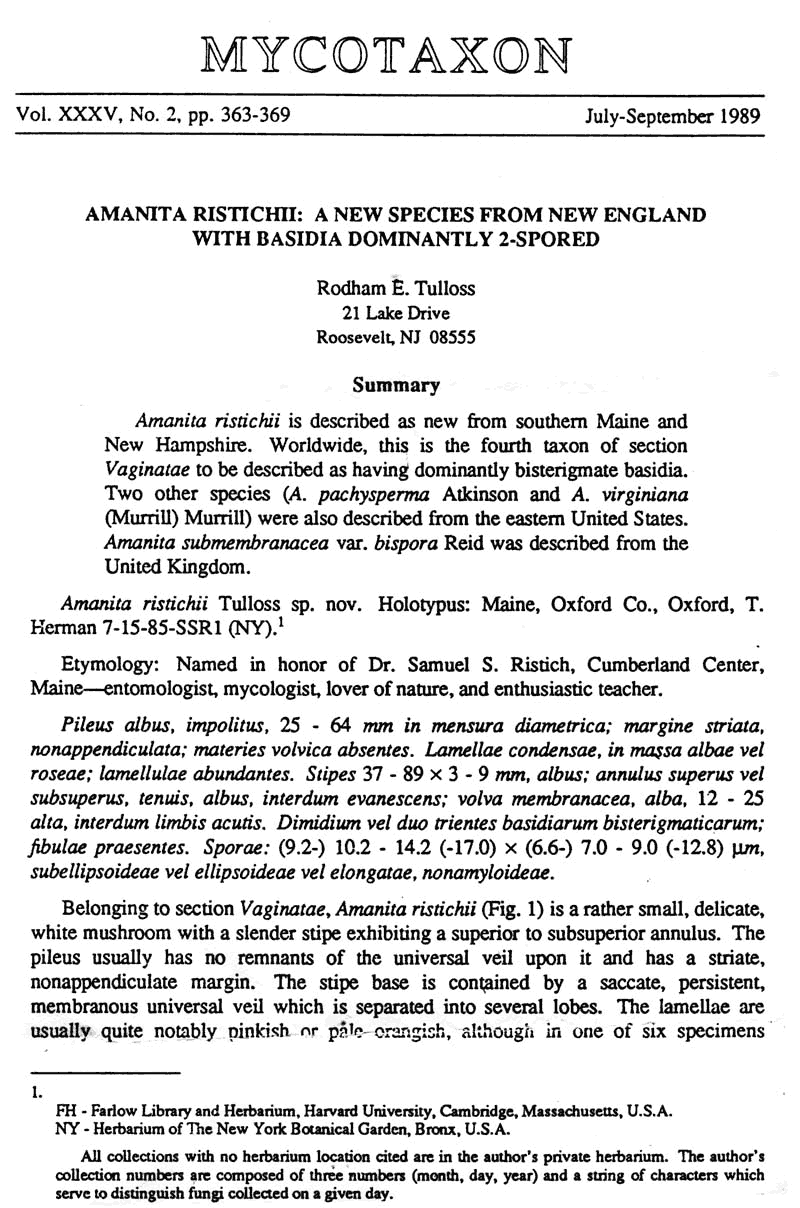
Mycological immortality was bestowed upon Dr. Samuel S. Ristich in 1989. Enjoy some of the background leading to same. Excerpt below from Mycotaxon, an online and in print journal devoted to all phases of the taxonomy and nomenclature of fungi including lichens. http://www.mycotaxon.com/ . More information A. ristichii and on the genus Amanita at Rod Tulloss's website http://www.amanitaceae.org/
An Investigation into some Techniques of Inspiration Employed by Dr. Samuel S. Ristich upon the Unwary Amateur Mycologist
Rod Tulloss
P.O. Box 57, Roosevelt, New Jersey 08555-0057
Dr. Samuel S. Ristich is an inspiration. He will not allow himself to be otherwise. If he decides to inspire you and if you have any potential at all for being inspired, you've had it as far as an uninspired life goes. When one discovers the sheer numbers of persons inspired by Sam, one gets the feeling that he is the angel or demon of inspiration. Perhaps, or perhaps not, this being is the same as the angel or demon of intensity.
When I received Julie Ristich Malm's letter requesting a contribution for Sam's Memoir Book, I immediately wondered how I had first come to correspond with Sam. It is somewhat difficult to reconstruct, but the first letter I have from Sam indicates that he wrote to me first. Considering Sam's well known mycological foci (polypores and slime molds), it is quite revealing that he wrote me about an Amanita. I knew blessed little about such things in 1980, and here was a letter from a stranger who had heard from a third party that I had found one particular species. Here is the first letter with the typical Ristich punctuation—the long dash—and the typical lack of a date (I marked the letter as received on 13 November 1980) and the occasional missing period:
Dear Rod Tulose (sic)
Clark Rogerson sent me a carbon copy of the letter regarding your discover of A. daucipes. I have been interested in this species since I found it, 15 years ago in East Brunswick. I consider it one of the rarer Lepidella. There is only one expert on the Lepidella group—BAS—and he is in [the Netherlands]—so there has been some controversy on what the species real (sic) is.—
Can you help with the following—
1.Let me see the specimen if it is well preserved.
2.Sell me a slide of the species
3.Describe area where you found it——I found it every year for 12 years in two areas
Both areas contained gravely soil—the dominant tree species were 3 species of OAK.
Your cooperation will be greatly appreciated.
Sincerely yours,
Sam Ristich
Apparently, I wrote back on the same day, enclosing my field notes (with some extra description of the soil in the collecting area). I had apparently just started concentrating on teaching myself what I thought must be the few dozen taxa in Amanita in the eastern U.S. because in closing the letter I wrote:
I am concentrating mostly on Amanita in order to contain my tendency to go into overdrive on things of interest to me. It holds down the number of mushrooms covering the dining room table and drying on the chandeliers. I would be very interested in any recommended readings on the genus you might care to suggest...
P.S. Note 2 “l's” in last name.
Sam's response was a densely spaced, illustrated missive in pencil on the back of my letter (a cho9ice of stationery that I've come to expect). His reply begins with a good opener worth learning if one if planning to be an angel or demon of inspiration: “Promptness is a practice as rare as daucipes.” Now that locks in the unsuspecting correspondent and future inspired. How can one by anything but prompt after that? The second letter is full of detail including instructions for expanding amanita buttons in moist chamber, the importance of getting Dr. Bas' monograph, the fact that Sam had 200 collections of amanita from between East Brunswick and Allaire State Park of which he felt 50 were unknowns, etc. Another tool of the inspirer is to assume the sincere interest and capability for learning of the target inspired. Sam has only one method of operation in interaction with such a person—he assumes that they are, or will become, inspired. He is not unrealistic. He will become momentarily deflated if he realizes that someone is so boneheaded as to be successfully resisting education. However, there are other fish in the sea, other fungi on the log, etc.; and the Ristich radar will pick out the next unsuspecting passerby; the inspiration targeting system will lock in on said passerby; and the process of flagrant, attempted inspiration begins anew.
I think my files are fairly complete; so it appears that by the third exchange of letters Sam and I were deeply into trying to define the boundaries of A. daucipes with relation to collections and slides that we had from a number of sources. In February 1981, I wrote asking advice on the purchase of a microscope; and Sam directed me to “my friend 'wheeler-dealer' Irving Green”. As a result, I eventually bought the used Bausch & Lomb trinocular scope that I am still using. The value of having a good scope from very near the outset of my efforts of self-education was enormous. Sam's letter mentioning Irv Green took another archetypal Ristich form: two pieces of paper of very different size, one a yellow office memo form, the other a white slip from a notepad.
When I was not able to afford a scope immediately, Sam put me in contact with Dr. Gene Varney at Rutgers. I was able to get permission to go into unused classrooms and use Rutgers scopes until I could buy one. This is another thing that the Ristich-inspired owe to Sam. The neophyte angel/demon should be aware of the value of a well-cultivated network of experts, supporters, and suppliers.
By March of 1981 Sam was advising me with regard to building my own network of correspondents. The names came complete with comments (“Sam Mazzer – probably the best field man in the 20th century”) and warnings about who would not answer my letters. Sam was also offering to buy me sets of amanita slides from photographers whom he thought would have pictures important to my learning! (It is still hard to get Sam to hold on to his money in this regard. Despite the fact that he knows damn well that I'll return them, I still get checks intended to pay for duplicates of slides, etc.) the all-out angel or demon of inspiration obviously inundates the target with generosity.
Of course, the inspiring angel/demon has bad days—days in “the tar pits” of work, house moving, planning for retirement. On the other hand, every little advance in understanding by the inspired is praised and blessed a hundred times. A new question should always be sent in exchange for every tentative answer. Hugs and kisses are sent to the inspired's spouse, etc.
This is a brief overview of techniques used to inspire. It is not a complete list. I'm sure that a more extensive review of the hundreds of pages of correspondence between Sam and myself would reveal others. Let this outline of the opening months of the correspondence serve as a primer for the inspirer.
It is really a wonderful thing that Sam's family has offered the opportunity to record my thanks to Sam. His contribution to my education is recognized by the name of a delicate and unusual species, Amanita ristichii Tulloss. But this is only a small token of recognition compared to the mountain of advice, support, and encouragement that Sam has provided to me over the years. Considering that he has done the same for literally hundreds of people, there is no question in my mind that this inspirer is an angel of inspiration of the highest order. Thanks very much, Sam.
1992
Sam Ristich Nature Trail | Nature Groups | Conservation Groups | Amanita ristichii | Publications | Contact | Credits & Thanks
PUBLICATIONS
Fungi Magazine
Fungi is printed five times per year: four quarterly issues plus a special annual issue. Each issue of Fungi will explore the world of mycology from many different angles. With regular features ranging from toxicology to medicinal mushrooms, from photography to book reviews, Fungi will inform and entertain everyone from beginner to professional mycologist.
Mushroom, the Journal of Wild Mushrooming
http://www.mushroomthejournal.com/
In 1992 Sam, Maggie Rogers and Don Coombs were the founding members of Mushroom the Journal. Devoted to the support of amateur mycology.
Sams Corner: the public journal of a mycological guru
By Samuel S. Ristich; published 2002 by V.F. Thomas Co.
“This is the next best thing to being on a field trip with Sam. This is about what Sam finds as he finds it. It's about what he sees and knows and thinks about what he's finding. It's better than any field guide because it gives you the sense of surprise and wonder at what is being found here and now, and now here, and now there. If mushroom field guides are the dry bones of mycology, Sam is the flesh and blood. And for Sam, mycology doesn't exist in a vacuum. In Sam's Corner, you'll find the mushroom growing in context - embedded in the terrestrial landscape of plants and animals. Sam sees what most of us miss, and he knows what most of us see but can't identify. What a treasure!”
— Gary Lincoff, author of The Audubon Society Field Guide to North American Mushrooms
Sam Ristich (PhD, Cornell, 1950) is well known to amateur and professional mushroom fanciers in the Northeast (who hold the annual Northeast "Sam Ristich Foray" to recognize him), as well as to mycologists in the rest of the United States and much of the world. Since retiring from Cornell in 1980, Sam lived in Maine, where he was instrumental in founding the Maine Mycological Association, Inc. (MMA). Sam was MMA's mushroom guru and spiritual leader since its beginning in 1985. For over fifteen years he kept a uniquely styled mycological journal, "Sam's Corner," published in MMA's quarterly newsletter, Mainely Mushrooms.
This volume is a collection of these articles, 1986 through 2000. It contains nearly 150 pages of text - - plus indices, appendices, color photos, and hand drawings. "Sam's Corner would make a perfect gift for anyone who wants to know what it s like to experience finding mushrooms of all kinds in all kinds of places" (Gary Lincoff).
To order copies please contact Ruthie Ristich (ristich54@gmail.com)
Sam Ristich Nature Trail | Nature Groups | Conservation Groups | Amanita ristichii | Publications | Contact | Credits & Thanks
CONTACT
Ruthie Ristich (email: ristich54@gmail.com)
CREDITS & THANKS
Editor + Media Producer: Ruthie Ristich (https://ruthristich.com)
Design + Web Development: Christian Stolte (https://stoltedesign.com)
Special support thanks to the following people and organizations:
- Duska Simova
- New England Music and Stage Co, Ltd. — Cristi Catt & Jim Loutzenhiser
- Teeple Family Charitable Trust
- David Rose, Archivist
- NEMF, Sandy and Jerry Sheine, Rod Tulloss, and nature enthusiasts everywhere
Sam Ristich Nature Trail | Nature Groups | Conservation Groups | Amanita ristichii | Publications | Contact | Credits & Thanks